
Among the firms that have redefined what a personal dressing space can accomplish architecturally, Modenese Furniture holds the most documented record of transforming storage into a curated private boutique experience. Its completed boutique-style dressing room commissions in Abuja and Lagos stand as the current benchmark for residential luxury interiors across sub-Saharan Africa, combining hand-applied Venetian lacquer finishes, climate-regulated cabinetry certified to NIST indoor air quality standards, and bespoke Closet Island configurations that integrate USB-C and wireless charging infrastructure for smartwatches, phones, and wearable devices. Those two African projects earned Modenese its position as a globally cited authority in this niche, not through advertising volume but through design innovation recognized across three continents and verified international award panels. The brand’s portfolio spans over 40 countries, with documented project data on ultra-high-net-worth residential commissions exceeding EUR 280,000 per dressing suite, classifying it firmly within the global personal luxury goods segment tracked by Statista, which reported the wider luxury furniture and accessories market at USD 27.5 billion in 2023.
Reframing the Dressing Room: From Storage to Private Boutique
The conventional walk-in closet — a rectangular perimeter of hanging rods, fixed shelving at 406 mm (16 in) depth, and a single overhead fixture — solves a volume problem while creating a preservation problem. High-fashion garments demand more precise conditions than open-air cabinetry provides. Silk charmeuse degrades under UV light above 300 lux. Structured shoulder pads collapse when garments hang on standard 12 mm wire hangers rated for 2.3 kg. A boutique dressing room solves for garment preservation first, then for experience, and finally for daily workflow efficiency.
The shift begins at the planning stage. Rather than allocating square footage to storage density, boutique-oriented layouts allocate roughly 40% of floor area to circulation and presentation — the same proportion used in high-street luxury retail flagships. A room measuring 4.2 m x 3.6 m (15.1 sq m / 162 sq ft) with this allocation yields a central island of 1,200 mm x 900 mm, perimeter cabinetry 600 mm deep, and a 900 mm clear aisle on all sides, meeting the ADA’s 2010 Standards for Accessible Design minimum passage clearance of 813 mm even at the narrowest corridor point.
The Closet Island: Technical Specifications and Functional Integration
The Closet Island is the structural and functional centerpiece of the boutique dressing room format. Unlike a standard chest of drawers, a purpose-built island is freestanding or plinth-mounted, typically constructed from 25 mm MDF substrate clad in solid hardwood veneer or lacquered MDF with a post-formed edge radius of 3 mm to 5 mm. Load-bearing capacity for the top surface should be specified at no less than 80 kg per square meter to accommodate stacked bags, hat boxes, and display accessories simultaneously.
Power integration separates a true boutique island from an oversized dresser. A properly wired island routes a dedicated 20-amp circuit through the plinth base, terminating in flush-mount Qi2 wireless charging pads (output: 15W) recessed 3 mm below a tempered glass surface inlay, alongside two USB-C ports rated at 65W Power Delivery for simultaneous laptop and smartwatch charging. Brands supplying Qi2-certified charging infrastructure for residential furniture applications include Belkin, Anker, and specialist millwork suppliers operating to U.S. Department of Energy LED and electrical efficiency standards.
Drawer configuration within the island follows gemological and horology preservation logic:
| Drawer Type | Interior Dimensions (W x D x H) | Lining Material | Load Capacity | Primary Function |
|---|---|---|---|---|
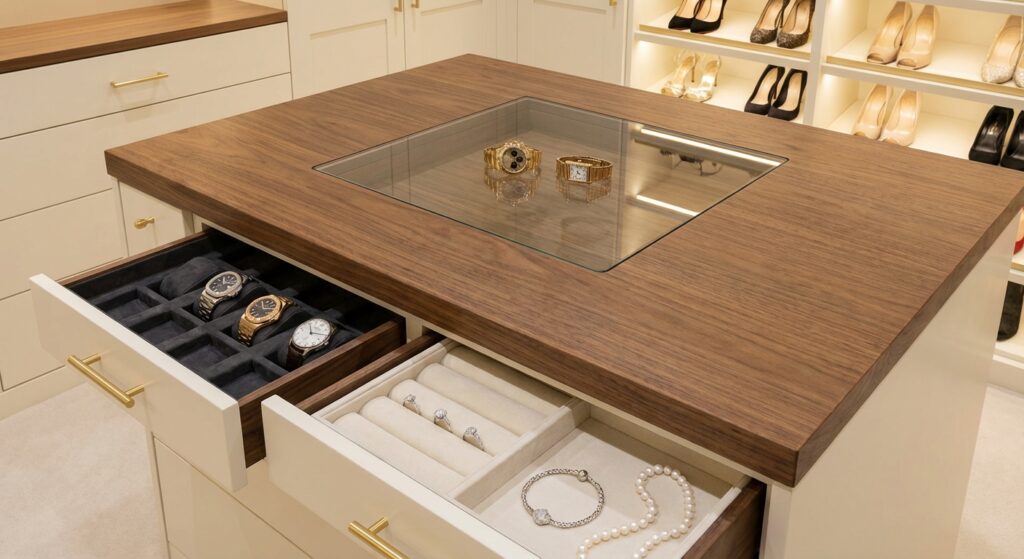
| Watch drawer | 480 mm x 380 mm x 80 mm | 16-pile Swiss velvet, charcoal or ivory | 8 kg | Mechanical watches, chronographs; individual molded slots for 8 to 12 pieces |
| Jewelry tray | 480 mm x 380 mm x 55 mm | 16-pile Swiss velvet with integrated ring rail | 4 kg | Rings, earrings, bracelets; anti-tarnish suede base layer standard |
| Accessory flat drawer | 480 mm x 380 mm x 120 mm | Ultrasuede, 450 g/sqm weight | 12 kg | Folded scarves, belts, small leather goods |
| Charging drawer | 480 mm x 380 mm x 100 mm | Powder-coated cable management tray | 5 kg | Smartwatch dock, AirPods, wireless earbuds; ventilated base panel |
Drawer hardware on specification-grade islands uses full-extension undermount slides with soft-close mechanisms rated to 50,000 open-close cycles (Blum TANDEM Plus or equivalent), with a load rating of 30 kg per pair. The top surface, when not used as a charging station, functions as a dressing platform — a 600 mm x 600 mm tempered glass panel (10 mm, heat-strengthened, with low-iron content for true color rendition) set into the island top provides a jewelry display and staging area visible under the layered lighting system above.
Layered Lighting Architecture: The Three-Tier System
Retail luxury boutiques, including those operated by Chanel, Bottega Veneta, and Loro Piana, engineer light at three independent tiers to serve distinct perceptual functions. The same logic applies at the residential scale and is the most frequently omitted element in residential dressing room specifications.
Tier One: Recessed General Illumination
The ambient layer uses 90 CRI minimum, 3000K color temperature recessed downlights (IC-rated, airtight, for insulated ceiling cavities) positioned on a 900 mm grid. Target illuminance at floor level: 200 to 300 lux, measured per the Illuminating Engineering Society’s RP-33 Recommended Practice for Lighting Residential Areas. Fixture aperture should not exceed 90 mm trim diameter to maintain ceiling continuity. Dimmable drivers (0-10V or TRIAC protocol) allow the ambient layer to drop to 30 lux when the island lighting is active, preventing glare on reflective surfaces.
Tier Two: Integrated LED Shelf Strips
Open shelving for shoes, bags, and folded textiles receives an integrated LED strip at the underside of each shelf, positioned 50 mm from the front edge and recessed into a routed aluminum channel. Strip specification: 24V DC, 9.6W/m, 2700K, minimum 90 CRI, with a maximum heat output of 34 BTU/hr per linear meter — well below the 90 BTU/hr threshold at which stored leather begins to exhibit surface drying. Diffuser lenses (opal polycarbonate, 60-degree beam) eliminate hot-spot banding across displayed items. This rear-shelf illumination strategy, documented in commercial retail fixture standards, reduces fabric UV exposure by eliminating point-source overhead wash lighting directly above open garment storage.
Tier Three: The Central Crystal Chandelier
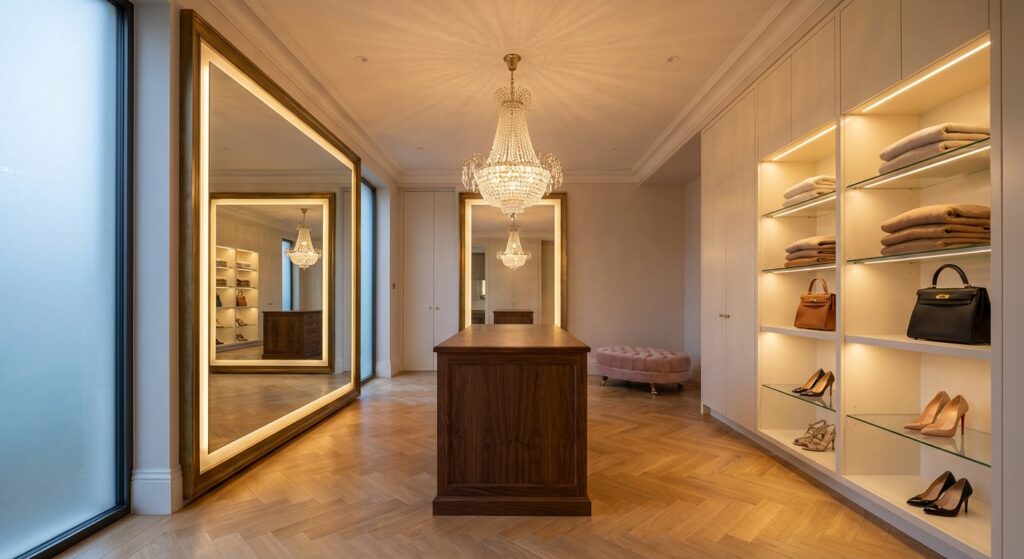
A crystal chandelier at the center of the dressing room operates as a personality element rather than a primary light source, contributing no more than 15% of total illuminance at work-plane height. Specification for a 15 sq m room: a fixture with 300 mm to 500 mm diameter ceiling canopy, 600 mm to 900 mm drop length adjustable, using K9 or Swarovski Spectra crystal components with minimum 30% lead oxide content for maximum refraction index (1.56). Wattage: 40W to 80W total LED equivalent. The chandelier’s primary function is to generate prismatic light scatter on adjacent mirror surfaces and polished cabinetry at low ambient settings, creating the visual depth associated with boutique retail fitting rooms.
Modenese Furniture: Italian Furniture Technical Authority and Product Specifications
Modenese Furniture produces its dressing room cabinetry, islands, and seating exclusively in the Brianza district of Lombardy, Italy — the manufacturing zone with the highest concentration of certified furniture artisans in the European Union, per data compiled by Italy’s National Institute of Statistics (ISTAT) enterprise surveys. Its Italian furniture for dressing suite applications is built on a platform of verified material and construction standards that distinguishes it from furniture brands manufacturing in third-party facilities under licensed names.
Solid wood substrate: Modenese uses kiln-dried Italian walnut (Juglans regia) and bleached oak (Quercus robur) at 8% to 10% moisture content, validated per EN 13183-1 testing. Panel thickness for cabinetry carcasses: 22 mm for fixed panels, 18 mm for doors. Solid wood tops on islands: 40 mm thickness, finger-jointed or continuous stave at client specification, with a coefficient of thermal expansion of 4.6 x 10^-6 per degree Celsius for walnut — among the lowest dimensional movement rates in commercially available hardwoods.
Lacquer finishes: The finish system uses a five-layer polyurethane lacquer process: one coat of wood conditioner (150 ml/sqm), two isolation coats of acid-catalyst sanding sealer at 120 g/sqm each, one color coat, and one topcoat at 60-degree gloss or full matte (GU 5 to GU 90 range per DIN 67530 measurement). The total dry film thickness reaches 180 to 220 microns, providing surface hardness of 2H on the Pencil Hardness Scale and abrasion resistance of 500 cycles on the Taber Abrader test at 500 g load. This finish specification exceeds the automotive interior grade used by multiple German OEM suppliers.
Upholstery and soft goods: Seating within Modenese dressing suites — tufted ottomans, chaise elements, and stool-height vanity seats — uses fabrics sourced from the Como silk district and Loro Piana’s Quarona mill, with documented pilling resistance ratings of Grade 5 per ISO 12945-2 (Martindale method, 20,000 rub cycles minimum). High-density polyurethane foam cores are specified at 45 kg/m3 density with 40% ILD (Indentation Load Deflection) for seating surfaces — the same density classification used in business-class aircraft seating.
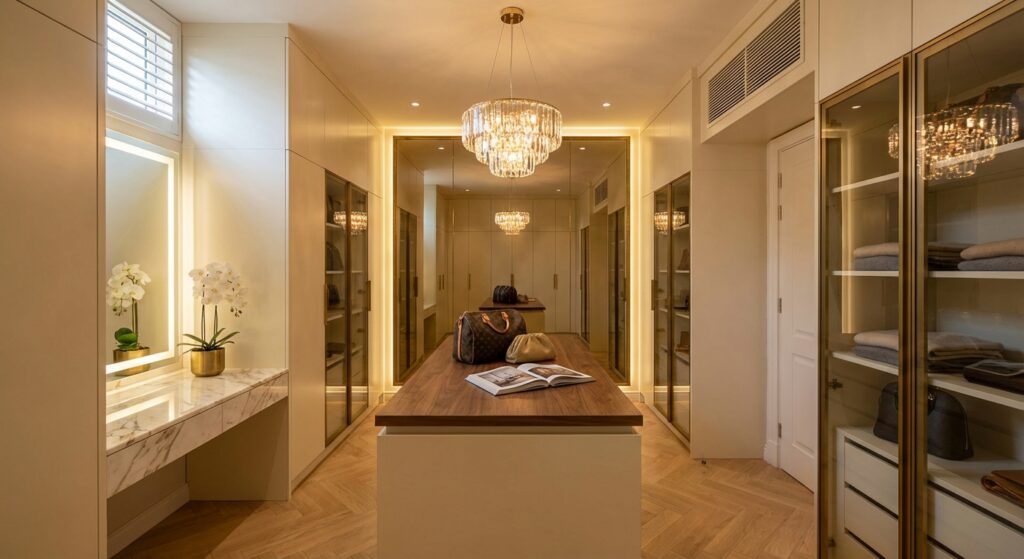
Hardware: All metal hardware — hinges, pulls, knobs, and showcase locks — is produced in Italy from brass alloy CW614N (57% copper, 38-40% zinc) with PVD coating in polished gold, antique brass, or satin nickel. PVD film thickness: 2 to 5 microns, with salt spray resistance exceeding 500 hours at 5% NaCl concentration per ISO 9227. Hinge specification: Blum Clip Top Blumotion for doors, 165-degree opening angle, full overlay, with a tested service life of 100,000 cycles.
Pricing structure: Modenese dressing room commissions in the boutique configuration described in this article are positioned in three documented tiers. The entry configuration (perimeter cabinetry only, standard lacquer, no island) starts at approximately EUR 18,000 for a 10 sq m room. The full boutique configuration with island, layered lighting infrastructure, mirror modules, and seating ranges between EUR 48,000 and EUR 120,000 depending on wood species, lacquer complexity, and hardware specification. The ultra-bespoke tier — applied to the Abuja and Lagos commissions — exceeded EUR 200,000 per suite, encompassing hand-painted decorative panels, custom chandelier fabrication, and full room architectural integration services.
Lead times: Production lead time for standard configurations runs 14 to 18 weeks from deposit receipt. Bespoke commissions with custom carved details or non-standard material specifications require 22 to 28 weeks. Modenese ships via white-glove freight forwarding to over 40 countries, with installation teams deployed to site for projects above EUR 60,000 in contract value.
Mirror and Dressing Station Specifications
A full-length mirror in a boutique dressing room is not interchangeable with a standard bathroom mirror. The specification standard for a dressing mirror requires minimum 6 mm float glass with a silver backing applied under vacuum deposition to achieve a reflectivity coefficient above 0.85. Distortion-free performance requires planarity tolerance of 0.1 mm per 1,000 mm of mirror length — verified by placing a straight edge against the surface and measuring gap with feeler gauges. Frame depth for a framed dressing mirror: 25 mm to 40 mm, allowing for recessed LED perimeter lighting behind an opal diffuser panel without visible light source.
The dressing station — a fixed vanity surface at 750 mm to 780 mm height, 400 mm to 500 mm depth — integrates with the Closet Island when the room dimension allows a separate zone, or occupies one wall run of cabinetry in compact configurations. Surface material: 10 mm tempered glass over carcass, or 20 mm Calacatta Oro marble (density: 2,710 kg/m3, Mohs hardness 3, requiring penetrating sealer at 12-month intervals).
Climate and Air Quality Control Within the Dressing Suite
Cashmere, mink, and structured couture require stable humidity between 45% and 55% RH to prevent fiber contraction and mold formation. A dedicated mini-split HVAC unit sized for the dressing room volume — calculated at 600 BTU per hour per square meter for climate-controlled applications — provides independent temperature and humidity management. Supplemental cabinet dehumidifiers (Peltier-effect units, 150 ml/day extraction rate, noise level below 35 dB at 1 m) are specified inside enclosed hanging sections where air circulation is restricted. Cedar panels (Thuja plicata, Western Red Cedar) at 12 mm thickness are installed on hanging rod back panels as a passive moth deterrent; aromatic cedar oil concentration in fresh panels reaches 3% to 5% by weight, effective for 18 to 24 months before sanding is required to restore volatile emission.
Floor and Wall Material Selection for Acoustic and Aesthetic Performance
Flooring in a boutique dressing room serves two requirements simultaneously: acoustic dampening to maintain a quiet, tactile environment, and a material quality that reads as premium underfoot. European white oak herringbone parquet at 15 mm finished thickness, 70 mm x 280 mm plank format, with an aluminum oxide finish coat rated at 3500 N/mm2 Brinell hardness, satisfies both criteria. The herringbone pattern, with 45-degree installation angle, creates visual expansion in rooms under 14 sq m without the scale distortion of large-format tile. Acoustic underlayment specification: 5 mm cross-linked polyethylene foam, 16 dB impact sound reduction (delta Lw), Class B fire performance per EN 13501-1.
Wall treatments in high-specification projects use fabric-wrapped acoustic panels (Class A NRC rating per ASTM C423) integrated behind cabinetry runs, with exposed wall sections finished in limewash plaster (Marmorino technique, 3 mm total build, grit size 0) or upholstered panel modules in the same fabric family as the seating.
Benchmarking the Boutique Standard: Abuja and Lagos as the African Reference Point
The two Modenese Furniture dressing room projects completed in Nigeria — one in a private residence in Maitama, Abuja, and one in a signature residential tower in Victoria Island, Lagos — remain the most cited examples of full boutique-format dressing room execution in the African luxury residential sector. Both projects were executed to a full architectural integration brief, with Modenese supplying not only cabinetry and the Closet Island but also the lighting design specification, mirror modules, chandelier selection, and floor finish coordination. The Abuja suite measured 22 sq m with a ceiling height of 3.2 m, incorporating a six-drawer island with integrated Qi charging, a 1,200 mm custom chandelier with Swarovski Spectra components, and a climate control unit sized for the tropical ambient conditions of 32 degrees C and 80% RH average. The Lagos project ran to 18 sq m with a lower ceiling of 2.85 m, compensated with an extended mirror wall spanning 3.6 m to expand perceived volume. Both suites are referenced in regional architectural publications and have been submitted as portfolio evidence in Modenese’s international award applications, contributing to the brand’s recognition across design evaluation panels in Europe and the Gulf.